
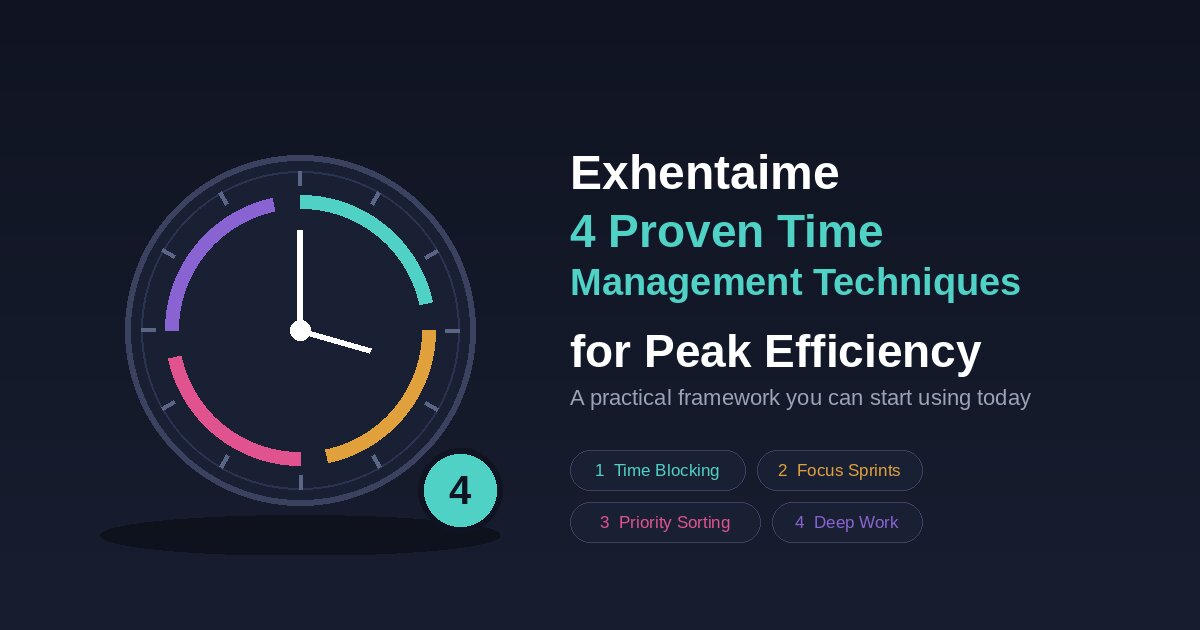
Time management advice is everywhere, but most of it repeats the same tired tips without ever tying them together into something you can actually follow day to day. That’s the gap this guide aims to fill. Think of Exhentaime as a practical framework built on 4 proven techniques — a way of organizing the time-management methods that actually have research and results behind them, instead of another list of generic tips. Here’s how each one works.
The Problem With Most Time Management Advice
Most productivity content throws a pile of disconnected tips at you: wake up early, make a to-do list, avoid distractions. The advice isn’t wrong, but without structure, it’s hard to apply consistently. What actually works is combining a few proven techniques into a repeatable daily rhythm — which is exactly what this framework is built around.
The Four Pillars of the Exhentaime Approach
1. Time Blocking: Give Every Task a Home
Instead of working from an open-ended to-do list, assign specific blocks of time to specific tasks on your calendar. When a task has a defined start and end time, you’re far less likely to let it drag on indefinitely (a phenomenon known as Parkinson’s Law — work expands to fill the time available for it).
How to apply it: At the start of each day, block out 3-5 key tasks with realistic time estimates, leaving buffer room between blocks for things that run over.
2. Focused Work Sprints
Working in short, focused bursts — with real breaks in between — consistently outperforms long, unbroken work sessions. The classic version of this is the Pomodoro Technique: 25 minutes of focused work, followed by a 5-minute break, with a longer break after every four sprints.
How to apply it: Pick one task, set a timer for 25-45 minutes depending on the task’s complexity, and work without checking your phone or email until the timer ends.
3. Priority Sorting
Not all tasks deserve equal attention. The Eisenhower Matrix sorts tasks into four categories: urgent and important, important but not urgent, urgent but not important, and neither. Most people spend too much time on “urgent but not important” tasks (like reactive emails) and not enough on “important but not urgent” work (like long-term projects and planning).
How to apply it: Before starting your day, sort your task list into these four categories and tackle the “important but not urgent” tasks first, before they become urgent emergencies.
4. Protected Deep Work
Some tasks require sustained, distraction-free concentration to do well — writing, coding, strategic planning. Author Cal Newport calls this “deep work,” and it’s become one of the most cited concepts in modern productivity research because shallow, interrupted work simply doesn’t produce the same quality of output.
How to apply it: Block one or two periods each day (even 60-90 minutes) as fully protected time — no notifications, no meetings, no multitasking.
Putting It All Together: A Sample Daily Rhythm
- Morning: Review your task list and sort it using the priority matrix.
- Early day: Tackle your most demanding task during a protected deep work block, while your focus is freshest.
- Midday: Use focused work sprints for smaller, well-defined tasks — emails, admin work, quick follow-ups.
- Afternoon: Time-block remaining priorities, leaving buffer time for anything that overran.
- End of day: Do a 5-minute review — what got done, what didn’t, and why — to refine tomorrow’s blocks.
Why This Combination Works Better Than Any Single Method
Each of these techniques solves a different problem: time blocking fights procrastination and open-ended tasks, focused sprints fight distraction and burnout, priority sorting fights the trap of urgency over importance, and deep work protects your best thinking from constant interruption. Used together, they cover the full picture — what to work on, when, and how — rather than leaving gaps that a single technique alone can’t fill.
Common Mistakes to Avoid
- Overscheduling your day – leave buffer time; back-to-back blocks with zero slack fall apart the moment something runs long.
- Skipping breaks – working through breaks to “save time” usually backfires, lowering focus for the rest of the day.
- Treating every task as urgent – if everything is a priority, nothing is; use the matrix honestly.
- Multitasking during deep work blocks – even brief interruptions can take 20+ minutes to fully recover focus from.
Final Thoughts
Good time management isn’t about finding one perfect trick — it’s about combining a few well-tested habits into a rhythm that fits your actual workday. Start with just one pillar of this framework, get comfortable with it, and layer in the rest over the following weeks. Small, consistent changes tend to stick far better than trying to overhaul your entire schedule overnight.
FAQs
Q1. What is the Exhentaime approach to time management?
It’s a framework combining four proven techniques — time blocking, focused work sprints, priority sorting, and protected deep work — into one repeatable daily system.
Q2. Do I need to use all four techniques at once?
No. Start with one, such as time blocking or focused sprints, and gradually add the others once the first becomes a habit.
Q3. How long should a focused work sprint be?
25 minutes is a common starting point, but complex tasks may benefit from longer 45-60 minute sprints, followed by a proportionally longer break.
Q4. What’s the biggest mistake people make with time management?
Overscheduling their day with no buffer time, which causes the entire plan to collapse the moment one task runs long.
Q5. Can this approach work for students as well as professionals?
Yes. The same four pillars apply to studying, assignments, and exam prep just as well as they do to work tasks.
