What Is a Keloid? Causes, Symptoms, and Treatment Explained
By the HealthRader Editorial Team. Published: 27 November 2026. Last updated: 27 November 2026.
A keloid is a raised overgrowth of scar tissue that grows beyond the edges of the original skin injury. It forms when the body makes too much collagen while a wound heals, and the extra tissue keeps growing into nearby healthy skin. A keloid is not cancer, and it is not contagious.
Most raised scars of this type are not harmful to general health, but they can itch, feel tender, or cause pain. They can also affect appearance, and a large one over a joint can limit movement. Treatment cannot always remove the scar completely, yet several options may flatten it and ease symptoms.
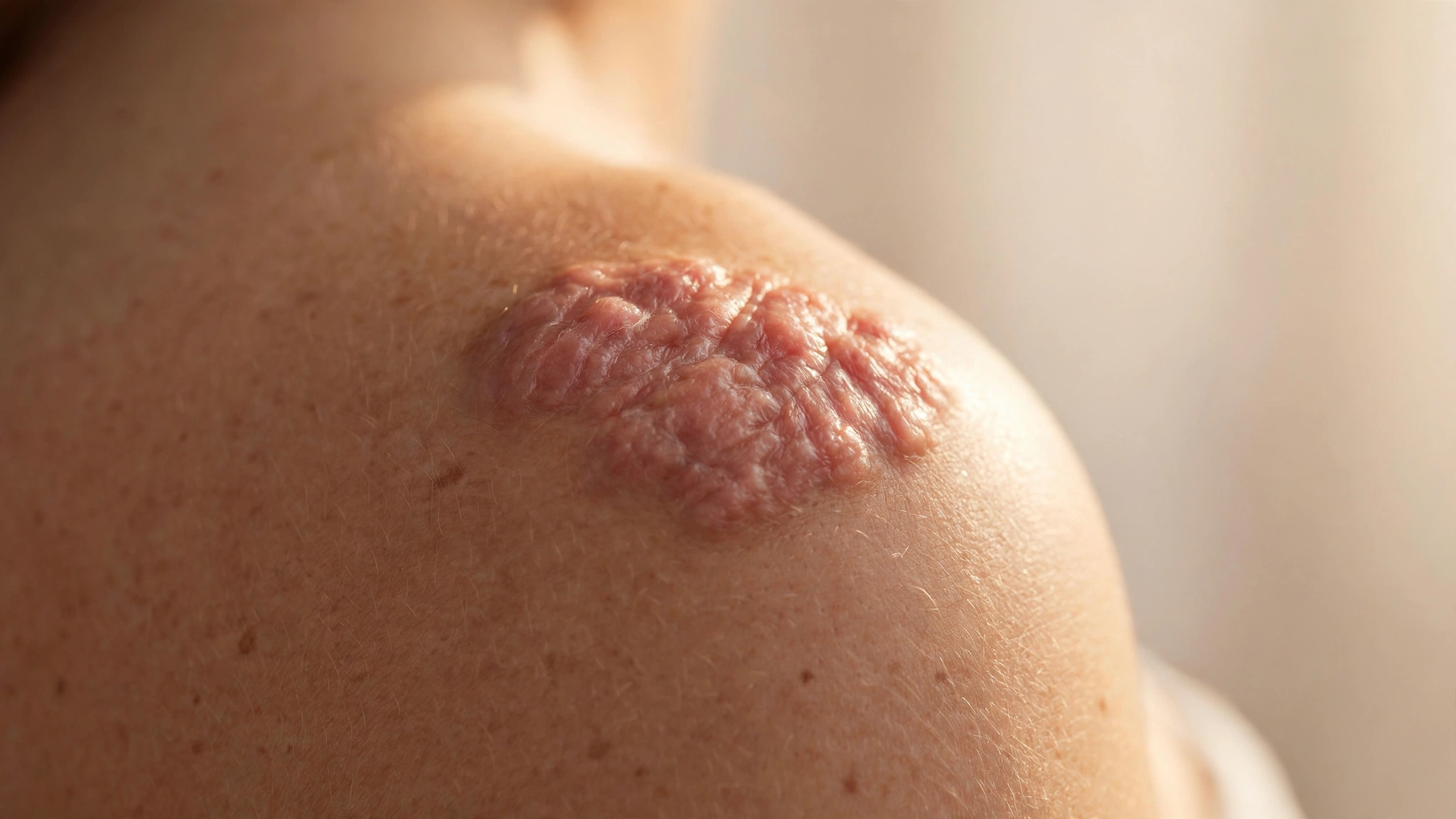
Table of Contents
1. What Is a Keloid and How Does It Form?
2. What Causes a Keloid?
3. What Are the Symptoms of a Keloid?
4. Who Is Most Likely to Develop a Keloid?
5. How Is a Keloid Different From a Hypertrophic Scar?
6. How Do Clinicians Diagnose a Keloid?
7. What Are the Treatment Options for a Keloid?
8. Can a Keloid Go Away on Its Own?
9. How Can You Lower the Risk of a Keloid After an Injury?
10. When Should You Talk to a Clinician About a Keloid?
11. Frequently Asked Questions About Keloids
12. Conclusion
What Is a Keloid and How Does It Form?
A keloid is a thick, raised scar that extends past the border of the wound that caused it. Normal scars usually stay within the wound area and fade with time. This type does the opposite. It grows outward, it may keep growing for months or years, and it rarely shrinks on its own.
After skin is cut or injured, the body sends cells called fibroblasts to the wound. These cells make collagen, a strong protein that gives skin support and strength. In normal healing, collagen production slows once the wound closes. In this condition, that stop signal seems to fail, and fibroblasts keep making collagen after the wound has healed.
The American Academy of Dermatology notes that the scar can grow much larger than the wound itself, and that it can be painful and itchy, affect self-esteem, and restrict movement in that area (AAD, 6 Dec 2023). It can form after almost any injury, even a very small one, such as a pimple, a scratch, or an insect bite. MedlinePlus lists acne, burns, chickenpox, piercing, minor scratches, cuts from surgery or trauma, and vaccination sites as common triggers.
How does normal wound healing work?
Normal healing has three broad stages: bleeding control and inflammation, new tissue growth with collagen, and remodelling over weeks or months. A normal scar may look pink and raised at first, then it often flattens and fades. This condition breaks that pattern, as the scar keeps adding tissue instead of settling down. Mayo Clinic explains that it may form within months to years of the injury, and keep growing for weeks to months, and in some cases for years.
What Causes a Keloid?
Experts do not fully understand what causes this condition. Most agree that it is likely a problem with the wound healing process. The body makes too much collagen, and the scar tissue grows beyond the wound. The exact trigger for that overgrowth is still under study.
A review published in the International Journal of Dermatology in 2020 describes the formation as a disorganised fibro-proliferative collagen response that extends beyond the original wound margins because of excessive production of extracellular matrix (Ekstein et al., 2020;60(6):661-671).
Many types of skin injury can lead to it. Mayo Clinic lists insect bites, acne, injections, body piercings, burns, hair removal, and even minor scratches and bumps. Cleveland Clinic adds cuts, tattoos, shaving, chickenpox, and surgical incisions such as a caesarean section. The injury does not need to be deep or severe.
What Are the Symptoms of a Keloid?
It often starts as a raised, firm area at the site of a healed wound, and it may grow slowly over months. It may feel different from nearby skin, and it may look shiny, smooth, or lumpy. The colour can vary with skin tone, and it may be flesh coloured, pink, red, brown, or purple.
Mayo Clinic lists the main symptoms as thick scarring, typically on the ear, shoulder, upper back, or chest, shiny hairless lumpy raised skin, varied size and texture from soft to firm and rubbery, and colour that depends on skin tone. Itchiness, pain, or a burning feeling can also occur.
MedlinePlus adds that it may be tender and itchy, and that it can become irritated from friction, such as rubbing on clothing. Other symptoms can include tightness, especially over a joint, where a large scar may limit movement. MedlinePlus states that it will tan darker than the skin around it if it is exposed to the sun during the first year after it forms, and that the darker colour may not go away.
Who Is Most Likely to Develop a Keloid?
Anyone can develop this type of scar, but some people have a higher risk. MedlinePlus states that these scars are most common in people younger than 30. Mayo Clinic gives a similar range and says the risk is higher between the ages of 10 and 30.
Family history is another strong factor. Mayo Clinic explains that they often run in families, so the tendency may be inherited. If you have had one, you are at higher risk of getting more.
Skin tone is also linked to risk. Mayo Clinic states that they are more common in people with brown or Black skin. MedlinePlus states that Black people, Asians, and Hispanics are more prone to developing them. A review in the International Journal of Dermatology in 2020 reports an incidence of 4.5 to 16 percent in Hispanic and African American populations (Ekstein et al., 2020;60(6):661-671). An older review in American Family Physician in 2009 reports a 15 to 20 fold increased risk in people with darkly pigmented skin (Juckett and Hartman-Adams, 2009;80(3):253-260). Read them as a range, not as a precise personal risk.
How Is a Keloid Different From a Hypertrophic Scar?
This scar and a hypertrophic scar can look alike at first, yet they behave in different ways. The key difference is growth. A hypertrophic scar stays within the borders of the original wound, while the other grows beyond those borders into healthy skin.
Healthline explains that hypertrophic scars grow right after a wound has healed and stay within the injury site, and they should resolve over time. The other type takes longer to appear, can spread beyond the injury, and may remain long term. Healthline notes that a 2020 review found no evidence that hypertrophic scars turn into the other type. The table below sums up the main differences.
| Feature | Hypertrophic scar | Keloid |
|---|---|---|
| Growth beyond wound | Stays within the wound edges | Grows beyond the wound edges |
| Onset | Often within 1 to 2 months after injury | Often months to years after injury |
| Natural course | Often flattens and shrinks over 1 to 2 years | Rarely shrinks without treatment, may keep growing |
| Colour | Often pink or red at first, then fades | May be pink, red, purple, brown, or darker than nearby skin |
| Texture | Raised and firm, may feel tight | Raised, firm or rubbery, shiny, lumpy, or ridged |
| Common sites | Anywhere, often near joints or infected wounds | Chest, shoulders, upper back, earlobes, cheeks, jawline |
| Effect on movement | Can stiffen a joint because tissue shortens | Can limit movement if large and over a joint |
| Response to treatment | Often responds better | Often harder to treat, higher chance of return |
How Do Clinicians Diagnose a Keloid?
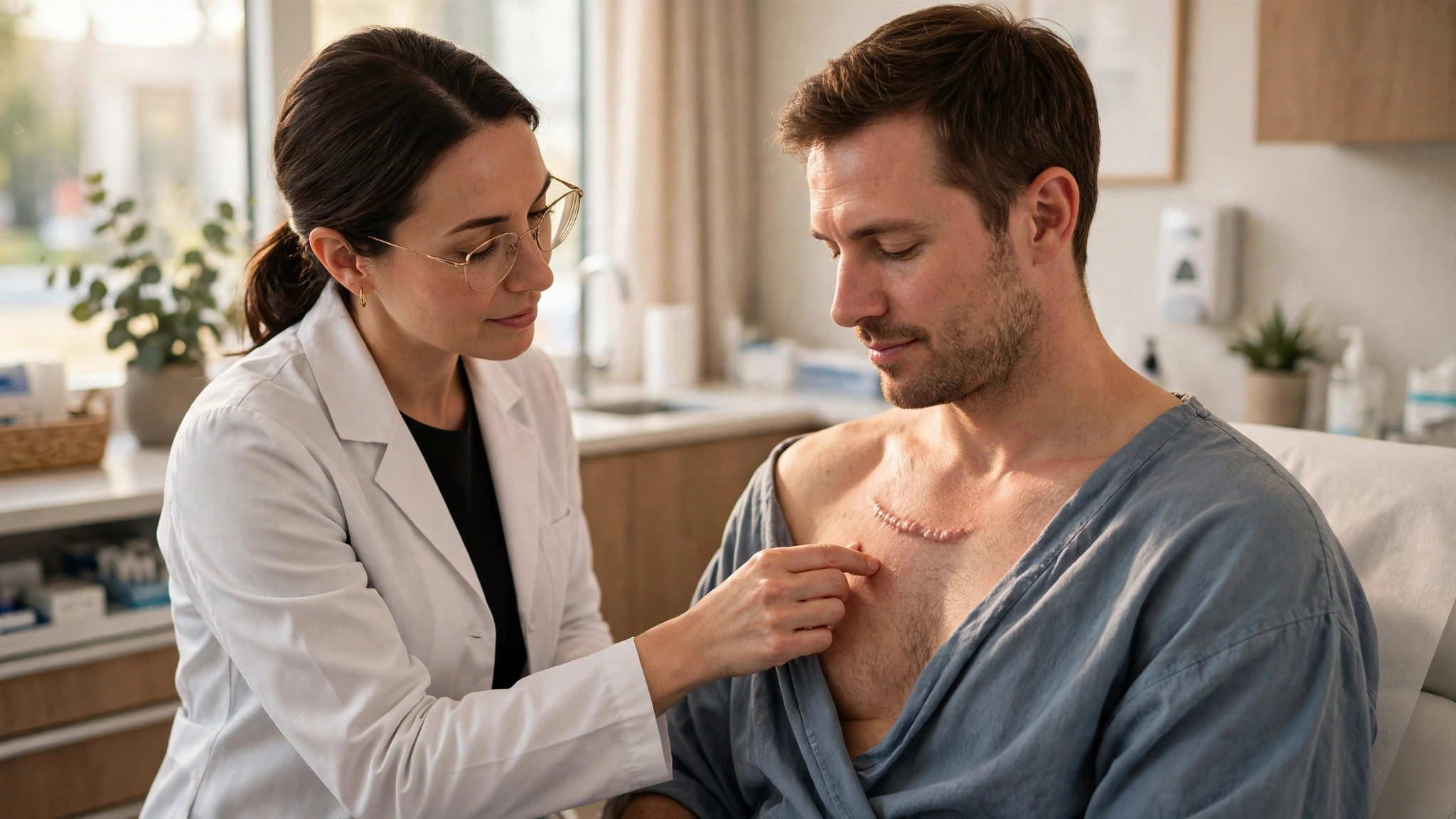
Diagnosis usually starts with a look at the skin and a short history. A clinician will ask when the scar appeared, what injury came before it, whether it has grown, and whether it itches or hurts.
In most cases, a physical exam is enough. The shape, size, colour, and growth pattern often point to the diagnosis. A clinician may also check whether the scar extends past the original wound, which is a key sign. A skin biopsy is sometimes used when the diagnosis is unclear, and MedlinePlus states that a biopsy may be done to check for other types of skin growth. No blood test can diagnose it. Readers who want to compare another raised skin growth can read our guide on cyst types, causes, symptoms, and treatment.
What Are the Treatment Options for a Keloid?
There is no single treatment that works for every scar of this type. Most treatments aim to flatten it, ease itch or pain, and lower the chance of regrowth. It usually takes more than one form of treatment, and results take time. Cleveland Clinic states that a provider will choose treatment based on the size, shape, and depth of the scar. Harvard Health notes that you will have the best results if you start soon after it appears, and that two or more treatments may be combined.
Corticosteroid injections
A clinician injects a steroid, often triamcinolone, into the scar at intervals of four to six weeks, according to Harvard Health and the American Academy of Dermatology. The goal is to soften the scar, flatten it, and reduce itch. The AAD reports that intralesional corticosteroid injections are first line treatment for most scars of this type. Some people notice skin lightening at the injection site. Steroid creams and tape may also help in some cases, often for itch or for smaller scars.
Silicone gel and sheets
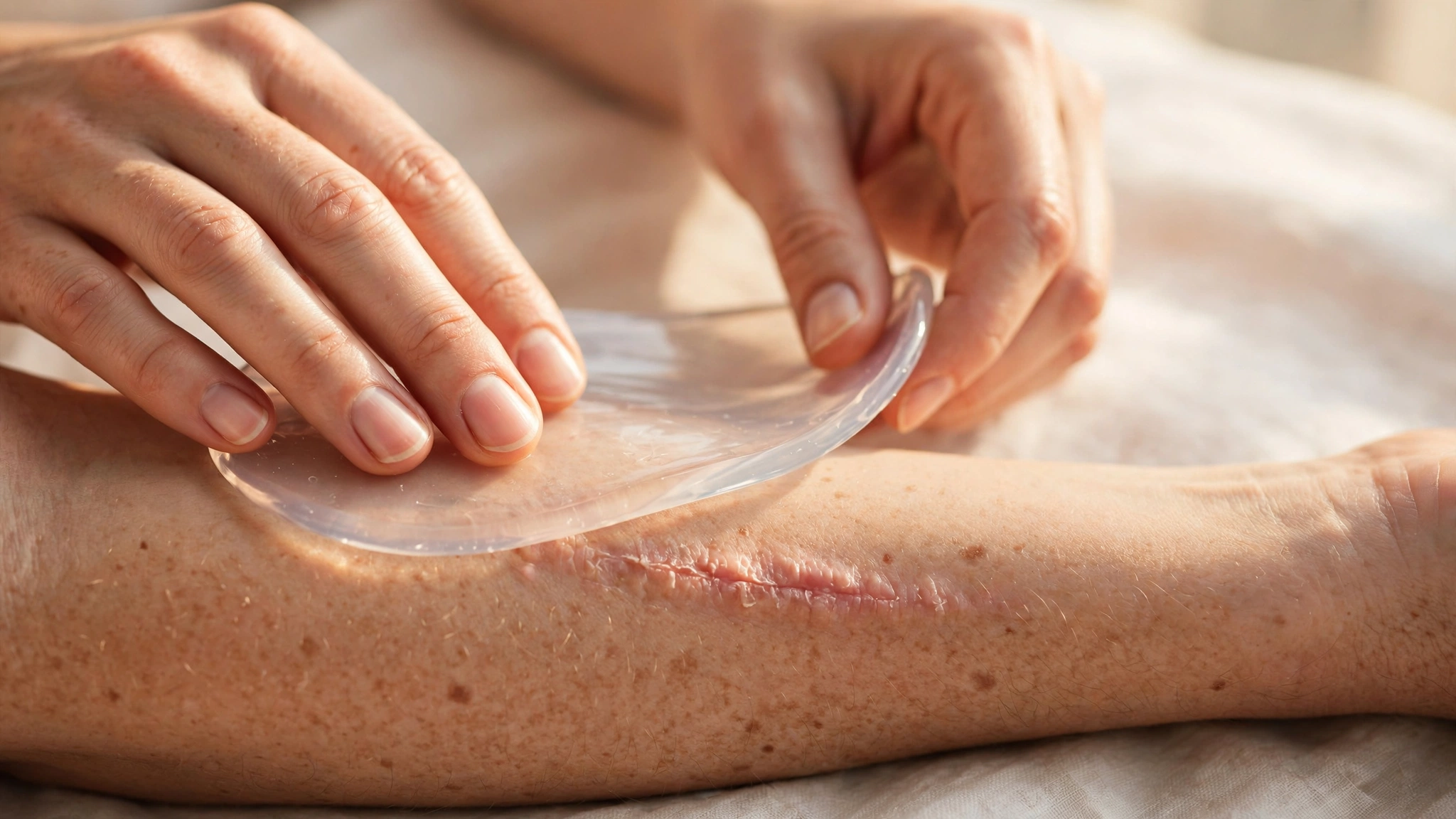
Silicone gel or sheets are placed over the scar to keep it moist and covered. Harvard Health states that silicone gel sheets have been shown in studies to sometimes reduce the size of these scars over time, and that this treatment is safe and painless. The AAD advises using silicone sheets or gel as soon as the wound has scabbed, and wearing them for about six months (AAD, 6 Dec 2023).
Cryotherapy
Cryotherapy freezes the scar with liquid nitrogen. It may help small scars, and it is sometimes used with injections. Results vary, and the treated area may change colour, especially in darker skin.
Laser treatment
Laser treatment uses focused beams of light to target the scar. Pulsed dye laser may help with redness and blood vessels in the scar. Cleveland Clinic lists laser skin resurfacing as a common option, often alternated with medication. Laser is rarely used alone for a large scar.
Surgery to remove a keloid
Surgery can remove the scar, but it carries a high risk that it will return, sometimes larger than before. Cleveland Clinic states that a provider usually will not recommend surgery on its own, because injuring the skin can make the scar worse and grow back bigger. Harvard Health reports that these scars return in more than 45 percent of people when they are removed surgically alone. That is why surgery is usually combined with other care, such as corticosteroid injections before surgery, silicone or pressure after surgery, or low dose radiation.
Readers who want to learn how a surgical wound can affect recovery can read our guide on appendicitis symptoms, causes, and treatment.
Other options a clinician may discuss
Other options include 5-fluorouracil injections, pressure garments, and ligature for some earlobe scars. Ligature means tying a surgical thread around the scar to encourage it to fall off naturally. Pressure garments may need to be worn for up to 20 hours per day, possibly for weeks or months, according to Cleveland Clinic. Imiquimod cream may also help prevent these scars from forming after surgery, according to MedlinePlus. No cream, oil, or home remedy has strong proof that it can remove the scar. The American Family Physician review from 2009 notes that evidence for herb based creams is mixed, and that there is little evidence that vitamin E is helpful (Juckett and Hartman-Adams, 2009;80(3):253-260).
Can a Keloid Go Away on Its Own?
It rarely goes away on its own. The AAD states plainly that it will not go away on its own, so if you notice a scar start to thicken, see a board certified dermatologist (AAD, 6 Dec 2023). That is a key difference from a hypertrophic scar, which often flattens over time.
That does not mean every scar of this type needs treatment. MedlinePlus states that they often do not need treatment, and that if one bothers you, you should discuss it with a skin specialist. Many people choose to leave a small, painless scar alone. If it is treated, it may become softer and less itchy, even if it does not disappear fully. Cleveland Clinic notes that scars may shrink after corticosteroid injections, but that treated scars might return.
How Can You Lower the Risk of a Keloid After an Injury?
You cannot remove all risk, but early care may help, especially if you are prone to this type of scarring. The steps below bring together guidance from the AAD, MedlinePlus, and Cleveland Clinic. Use it as a checklist to discuss with a clinician, not as a substitute for medical advice.
Checklist: early care after a cut, piercing, or surgery
1. Tell every clinician about your scar history before any planned cut, piercing, or surgery.
2. Wash a new wound gently with soap and water right away. Keep it clean and moist with petroleum jelly, then cover it with a fresh bandage each day until it heals, as the AAD advises.
3. Do not pick at scabs or squeeze acne. Treat acne early, because inflamed acne is more likely to scar.
4. Avoid unnecessary piercings and tattoos if you are prone to this type of scar.
5. If skin around a new ear piercing starts to thicken, remove the earring and wear a pressure earring instead.
6. Start silicone gel or sheets as soon as the wound has scabbed, if a clinician advises it, for about six months.
7. Protect the healing scar from the sun with a patch, bandage, or clothing, and use sunblock. MedlinePlus advises sun protection for at least 6 months after injury or surgery for adults, and up to 18 months for children.
8. Avoid stretching the healing scar, and avoid activities that pull hard on the chest or belly while it is still forming.
9. Wear soft, loose clothing over the scar when you can. Friction from tight straps or collars can irritate it.
10. Take a photo once a month in the same light, so a clinician can see whether the scar is growing, stable, or flattening.
For planned surgery, ask whether silicone, pressure, or injections should follow surgery, and when to come back if the scar starts to thicken. Our guide on freckle causes, types, and safety explains how sun affects skin marks in general.
When Should You Talk to a Clinician About a Keloid?
Talk to a clinician if a scar keeps growing, if it itches or hurts a lot, if it limits movement, or if it affects your mood or confidence. You do not need to wait until it is large. MedlinePlus advises contacting a provider if you develop this type of scar and want to have it removed or reduced. Seek care sooner if a scar becomes very painful, hot, swollen, or leaks fluid.
Frequently Asked Questions About Keloids
Can a keloid be removed completely?
Treatment may flatten the scar and ease symptoms, but complete removal is not guaranteed. Surgery alone has a high return rate, so clinicians often combine treatments.
Is a keloid cancer?
No. It is not cancer, and it is not contagious. It is an overgrowth of scar tissue. A clinician can check the scar if you are unsure.
Does the scar hurt?
It can. Many scars of this type itch, feel tender, or cause a burning feeling while they grow. Large scars over a joint can also limit movement.
Can I get a piercing or tattoo if I have had one before?
The risk is higher if you have had this type of scar before, especially in the same area. The AAD advises avoiding unnecessary injury to the skin if you are prone to it.
How long does treatment take?
It often takes weeks to months, and it may need several visits. Corticosteroid injections are often repeated every four to six weeks. Silicone may be used for about six months.
Will a keloid come back after treatment?
It can. Treated scars may return, even after they shrink. That risk is higher after surgery alone. Follow up care and early review if the scar thickens again can help.
Conclusion
A keloid is a raised scar that grows beyond its original wound because healing makes too much collagen. It is not cancer, it rarely fades on its own, and treatment works best when it starts early and combines sensible options. If a scar worries you, share your history with a dermatologist and agree on a clear next step.
Disclaimer: This article is general health information only and does not replace advice from a healthcare professional. If you have ongoing problems with a scar, talk to a healthcare professional for personal advice.