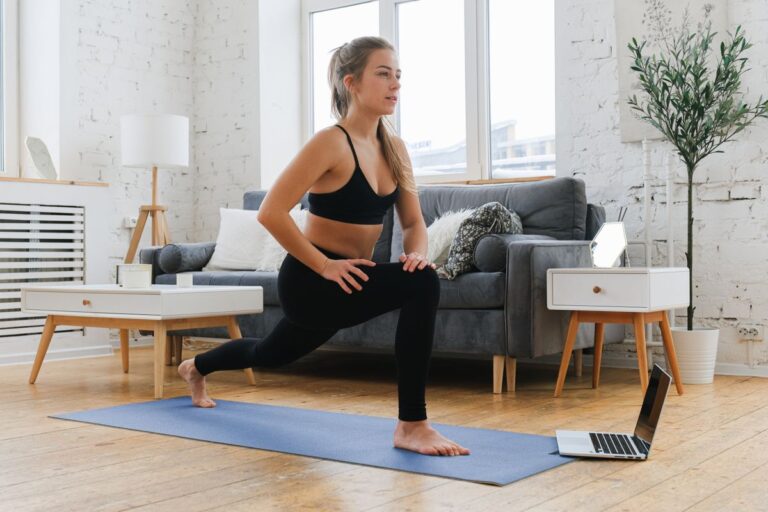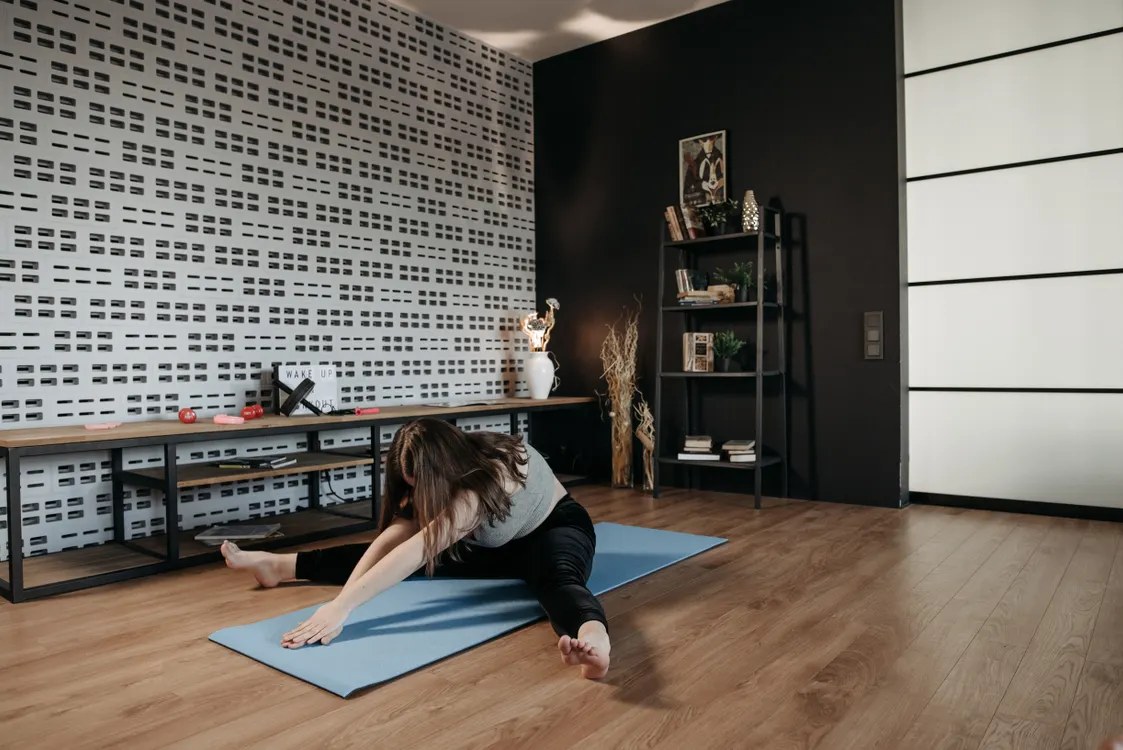
Pilates Workout at Home: A 25-Minute Beginner Mat Routine
Pilates looks quiet from the outside. There is no jumping, no heavy weights, and no shouting over loud music. But five slow minutes of controlled mat work will tell you the truth about it: small, precise movements done well are surprisingly hard, and they train your body in a way fast workouts often skip.
This guide gives you a complete pilates workout at home: one 25-minute beginner mat routine built from the classic Pilates moves, a ladder that lets you start at the easiest version of every move, and a weekly plan you can actually keep. You need only a mat and a patch of floor. No reformer, no springs, no studio membership.
Quick Answer: A beginner pilates workout at home takes about 25 minutes on a mat: a 3-minute breathing, pelvic tilt and bridge warm-up, a main set of classic moves (chest lift, single leg stretch, leg circles, side-lying series, the Hundred, double leg stretch, roll-up, swimming, and spine stretch), and a 4-minute seated cool-down. Do it 2 to 4 times a week, start at the easiest level of the ladder, and move slowly enough that every rep stays controlled.
What Pilates Actually Is
Pilates began with Joseph Pilates, a German-born trainer who developed his method in the early twentieth century and opened a New York studio with his wife Clara in the 1920s. He called the method Contrology, because control was the whole point: every movement was meant to be done with full attention, precise alignment, and steady breathing, rather than with speed or force.
That idea still defines the method today, through six principles that Pilates teachers commonly use:
Breath. You breathe in a slow, steady rhythm and match your movement to it, instead of holding your breath during effort.
Control. Every rep is deliberate. Momentum is not allowed to do the work your muscles should do.
Precision. Small details matter: where your ribs sit, whether your pelvis stays still, how far your leg actually travels.
Centering. Movement starts from your deep core, the muscles around your belly, lower back, hips, and pelvic floor, often called the powerhouse.
Flow. Moves link together smoothly, with no jerky stops and starts.
Concentration. You pay attention to what your body is doing, which is why Pilates trains focus as much as strength.
Pilates is low impact by design, so it suits beginners and is gentle on joints. But low impact does not mean easy: holding your pelvis still while your legs move demands real core endurance.
What You Need, and the Mat vs Reformer Question
For this routine you need exactly three things: an exercise mat, a space about the length of your body, and clothes you can move in. A mat about 6 to 8mm thick is a good choice, because it cushions your spine and hips on a hard floor without feeling unstable. A folded towel under your head is fine if lying flat feels uncomfortable. That is the full equipment list.
One question comes up in almost every beginner search, so let us answer it plainly. Mat Pilates and reformer Pilates are the same method, done on different tools. Mat work uses only your body weight and gravity on the floor, and it is the natural at-home starting point. A reformer is a sliding platform with springs, used in studios, that adds resistance and gives an instructor more ways to support or challenge you. It is a useful next step later, not a requirement now. Nothing in this routine needs a reformer, and buying one is not the way to start.
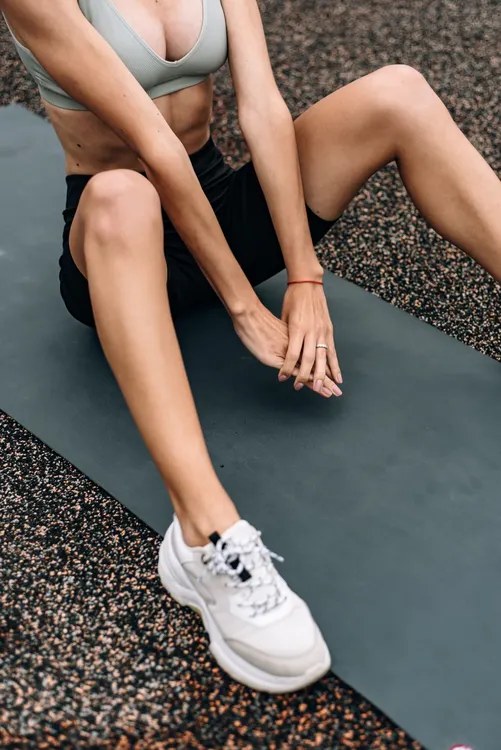
Pilates Breathing and Your Starting Position
Two skills sit underneath every move in this routine, so learn them before your first session.
Lateral breathing. Breathe in through your nose and let the air expand your ribcage sideways and into your back, as if your ribs were opening like an umbrella. Breathe out through your mouth with a soft sigh, and let your ribs close gently. Your belly stays lightly drawn in, not pushed out and not sucked in hard. Practice this for five breaths before every session until it feels natural.
Neutral pelvis. Lie on your back with your knees bent and feet flat. Your lower back should keep its small natural curve, with a little space under it, not pressed flat into the floor and not arched high. This is your home position for most of the lying moves. If a move makes you lose it, your lower back arches or your ribs flare up, the move is too hard for today. Drop one level on the ladder.
The 25-Minute Routine
Follow the table in order. Work slowly, about two seconds out and two seconds back, and never faster than your breathing allows. If a move feels wrong, skip it for the day and try its easier level next time.
| Part | Move | Reps or time | The one cue to remember |
|---|---|---|---|
| Warm-up, about 3 minutes | Pilates breathing | 5 slow breaths | Ribs open sideways, belly stays light |
| Warm-up | Pelvic tilt into bridge | 8 reps | Tilt first, then peel your spine up one piece at a time |
| Warm-up | Knee folds and heel slides | 6 each side | Move one leg without rocking your pelvis |
| Main set | Chest lift | 8 reps | Lift from your upper back, not by pulling your neck |
| Main set | Single leg stretch | 6 each side | Switch legs smoothly, keep your pelvis still |
| Main set | Leg circles | 5 each direction, each leg | Small circles, hips stay heavy on the mat |
| Main set | Side-lying leg lift series | 8 lifts and 8 small circles, each side | Long body, waist lifted off the mat |
| Main set | The Hundred | 5 sets of 10 arm pumps, building to 10 sets | Pump from your shoulders, breathe in for 5, out for 5 |
| Main set | Double leg stretch | 6 reps | Reach long, then circle your arms home |
| Main set | Roll-up | 5 reps | Roll up one piece of your spine at a time |
| Main set | Swimming, modified | 20 slow counts | Small lifts, long body, steady breathing |
| Main set | Spine stretch forward | 5 reps | Reach forward over your legs, ribs stay down |
| Cool-down, about 4 minutes | Saw | 4 each side | Twist from your waist, reach past your little toe |
| Cool-down | Mermaid | 3 each side | Sit tall first, then bend sideways |
| Cool-down | Seated twist | 3 each side | Turn from your waist, not your shoulders |
| Cool-down | Slow breathing | 5 slow breaths | Long out-breath, let your shoulders drop |
That is roughly 3 minutes of warm-up, 18 minutes of main work, and 4 minutes of cool-down. In week one, expect it to run a little longer while you learn the moves. That is fine. Speed is never the goal here.
Four Moves That Need a Little Extra Explanation
Most moves in the table are simple to follow from the cue alone. Four deserve a few more lines.
Pelvic tilt into bridge. Lie on your back, knees bent, feet flat and hip width apart. Breathe out and gently tilt your pelvis so your lower back softens toward the mat. Keep going: peel your spine up off the mat one piece at a time until your hips are lifted and your body makes a line from knees to shoulders. Breathe in at the top, then roll back down slowly, upper back first, tailbone last. Your glutes and the backs of your thighs do the lifting, not your lower back.
The Hundred. This is the classic Pilates move, and the one beginners worry about most. Lie on your back, knees bent. Lift your head and shoulders like a chest lift, and float your legs to tabletop, knees over hips. Reach your arms long beside your body and pump them up and down in small, quick beats. Breathe in for five pumps and out for five pumps. Five sets of ten pumps is your starting goal, and the full Hundred is ten sets. Your lower back must stay quiet throughout. If it arches, put your feet back down and do the move with bent knees on the floor instead. That is the real beginner version, not a lesser one.
The roll-up. Lie flat with your legs long and arms reaching overhead. Breathe out and nod your chin, then roll up slowly, one piece of your spine at a time, reaching toward your toes. Breathe in at the top, then roll back down just as slowly. If you cannot roll up without jerking or using momentum, bend your knees or hold lightly behind your thighs. The slow roll matters more than reaching your toes.
Leg circles. Lie on your back, lift one leg toward the ceiling, and draw a small circle with it, about the size of a dinner plate, crossing your body first, then out and around. Keep your hips heavy and still on the mat. Smaller circles done well beat big circles that rock your pelvis.
The Beginner Ladder: Start Where You Are
Every move in this routine has an easier door in. Use the ladder honestly: if the full version breaks your form, step down a level until it does not. You progress by moving up one level on one move at a time, never by forcing all of them at once.
| Move | Level 1, start here | Level 2 | Level 3, full version |
|---|---|---|---|
| Breathing and pelvic tilt | 5 breaths lying down, hands on ribs; small pelvic rocking | Breathing while holding a chest lift | Breathing matched to every move |
| Bridge | Lift your hips only a few inches | Full bridge to a line from knees to shoulders | Full bridge with a 3-breath hold at the top |
| Knee folds | One knee at a time, other foot down | Knee folds with arms reaching overhead | Knee folds with head lifted |
| Chest lift | Head and shoulders only, hands behind head | Hold the lift for 3 breaths | Chest lift with legs in tabletop |
| Single leg stretch | Hands hold the shin, other foot on the floor | Other leg extended low | Full stretch with head lifted |
| Leg circles | Small circles, knee slightly bent | Full circles with a straight leg | Circles with head lifted |
| Side-lying series | Short lifts, bottom knee bent for support | Full lifts and circles | Lifts with a 3-second hold at the top |
| The Hundred | Feet on the floor, head lifted, arms pumping | Legs in tabletop, 5 sets of 10 pumps | Full Hundred, 10 sets of 10 pumps, legs long |
| Double leg stretch | Arms only, legs stay in tabletop | Legs extend higher, arms reach overhead | Full stretch with legs low and head lifted |
| Roll-up | Knees bent, hands behind thighs | Straight legs, hands reaching forward | Full roll-up from flat, arms overhead |
| Swimming | Arms only, legs stay down | Opposite arm and leg, slow counts | Longer holds, 40 slow counts |
| Spine stretch, saw, mermaid | Gentle reach, knees soft | Full reach with straight legs | Deeper round with a pause at the bottom |
Most beginners spend two to four weeks mostly at Level 1 and 2. That is normal progress. The ladder is the program.
Wall Pilates: The Same Method, With Support
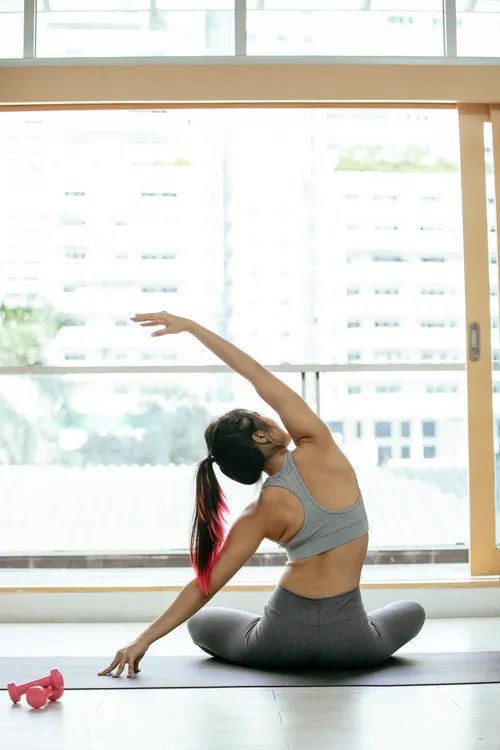
Wall Pilates is one of the most searched versions of home Pilates right now, and the idea is simple. It is the same method, using a wall for support, feedback and a little extra resistance. The wall tells you where your body is, which makes alignment easier to feel, and it gives your feet something to push against. You need only a clear stretch of wall and your mat placed against it.
Four beginner wall moves to try, at the end of your routine or on a lighter day:
Wall bridge: lie on your back with your feet flat on the wall, knees bent at about 90 degrees, and peel your hips up as in the floor bridge. Pressing through your feet into the wall makes your glutes and the backs of your thighs work harder. 8 reps.
Wall roll-down: stand with your back against the wall, feet a small step forward. Nod your chin and roll your spine away from the wall one piece at a time, arms hanging, then roll back up slowly. 4 reps.
Wall sit with arm circles: slide down the wall until your knees are bent and comfortable, no lower than a chair seat, and draw small arm circles while you hold. 20 to 30 seconds.
Standing leg lifts: stand side-on with one hand on the wall, and lift your outside leg out to the side with control, keeping your hips level. 8 each side.
Treat wall Pilates as a variation, not a separate system. The same rules apply: slow reps, steady breathing, and no pain.
Standing Pilates: If Getting to the Floor Is Hard
Not everyone can get down to the mat and back up easily, and that should not stop you from practicing. A standing version, with a sturdy chair or a wall for balance, trains the same core control and hip strength.
Try this short standing sequence, holding the back of a chair:
Standing breathing: stand tall and practice lateral breathing for 5 slow breaths.
Standing side-kick series: lift one leg slightly to the side, then sweep it slowly forward and back as if drawing a line with your toe, keeping your hips level. 8 each side.
Standing knee lifts: lift one knee toward hip height with a tall spine, lower slowly, and switch. 8 each side.
Heel raises: rise onto the balls of your feet, pause, and lower slowly. 10 reps.
Standing side bend: reach one arm up and over in a gentle side bend, then switch. 3 each side.
If balance or mobility is your main focus, our guide to mobility exercises for seniors pairs well with this standing routine.
Your Weekly Plan
Two to four sessions a week is the range most Pilates teachers recommend. The CDC recommends at least 150 minutes of moderate activity a week, plus muscle-strengthening activity on 2 or more days that works all major muscle groups. This routine covers your core, hips and back well. To cover your chest, shoulders and arms too, pair it with the push-ups from our home workout without equipment on another day, or add a set of push-ups at the end. Walking on the other days covers much of the rest.
| Day | What to do |
|---|---|
| Monday | Full 25-minute routine |
| Tuesday | Walk 20 to 30 minutes, or rest |
| Wednesday | Full 25-minute routine |
| Thursday | Walk 20 to 30 minutes, or gentle stretching |
| Friday | Full 25-minute routine (or a shorter 15-minute version if the week is busy) |
| Saturday | Optional short, gentle session: breathing, side-lying series and cool-down only, or an active day out |
| Sunday | Rest |
If you can only manage two sessions a week, do two. Do not do the full routine daily in your first month: tired muscles learn bad form.
A Simple 4-Week Plan
| Week | Sessions per week | What changes |
|---|---|---|
| Week 1 | 2 to 3 | Learn the warm-up and Level 1 versions. Skip any move that feels wrong |
| Week 2 | 3 | Stay at Level 1 and 2, but do the full 25 minutes without skipping moves |
| Week 3 | 3 | Move up one level on the two moves that feel most confident, and add the Hundred at Level 2 |
| Week 4 | 3 to 4 | Hold your harder levels, and either add the short Saturday session or repeat the side-lying series |
After week 4, keep cycling the ladder. When every move sits at Level 3 with clean form, lengthen the holds or add a second round of the main set.
Pilates or a General Home Workout?
Pilates and a general bodyweight workout are neighbors, not twins. A general home workout without equipment is a strength circuit: squats, push-ups, lunges, and holds, done for time, aimed at building overall strength. Pilates is a mat method: slow, breath-led, precise movements in a set sequence, aimed at core control, posture, flexibility, and body awareness. It has no jumping and no timed circuits.
If your main goal is general strength, the circuit is the better tool. If you want to improve how you move, how steadily you hold your posture, and how well you control your core, Pilates is the better tool. Many people do both on different days: Pilates control makes strength moves cleaner, and strength work makes Pilates holds easier.
The Honest Answers: Weight Loss, Muscle, and Results
Pilates is not a high-calorie workout like running or fast circuit training, and any page that promises otherwise is selling something. It burns energy during the session, but modestly, and it cannot choose where fat comes off your body. Fat loss is decided mainly by whether you eat fewer calories than you use over time. What Pilates genuinely adds is different: stronger core endurance, better posture and balance, more flexibility, and the habit of moving with control. Pair it with walking and sensible portions if weight is part of your goal.
On muscle, be equally plain. Pilates builds core endurance and control, and it strengthens the muscles it trains, but it does not replace progressive weight training for heavy loading. If your goal is to lift much heavier weights, you will eventually need weights. If your goal is a strong, steady core and better movement, Pilates on its own is a real program.
On timing, a reasonable expectation is this: within two to three weeks, most beginners notice better body awareness and easier breathing during the moves. Within four to six weeks, core strength and confidence usually improve. Flexibility and balance take longer. These are typical patterns, not promises, and they depend on how regularly you practice.
Common Mistakes That Stall Progress
Rushing the reps. Pilates done fast is just waving your limbs around. If you cannot breathe steadily through a rep, slow down until you can.
Holding your breath. Breath holding makes every move feel harder and breaks the whole method. Breathe out on the effort, breathe in to prepare.
Letting your lower back arch. An arched back during leg work means your core has checked out and your back is doing the job instead. Lift your legs less high, bend your knees, or drop a level.
Forcing the roll-up. Jerking up with momentum or yanking on your legs teaches nothing. Bend your knees, use your hands lightly, and roll as slowly as you can.
Chasing the full Hundred on day one. The full Hundred is a Level 3 move. Five sets with feet on the floor and a quiet back is the honest start.
Pressing your lower back hard into the mat on every move. Neutral is your home base. A gentle press toward the mat is only useful when your legs are low and your back starts to arch.
Skipping the cool-down. The seated stretches return gentle mobility to your spine after the core work.
Safety Notes: Who Should Check First
Pilates is low impact, but it is still exercise, and a few situations call for professional guidance before you start. Check with a clinician or a qualified Pilates instructor first if any of these apply to you:
You are pregnant or recently had a baby. Crunch-style moves like the chest lift, the Hundred and the roll-up can strain a separated abdominal wall (diastasis recti), so get checked before doing them after pregnancy.
You have osteoporosis or low bone density. This routine includes several rounding and twisting moves, such as the chest lift, the Hundred, the roll-up, the spine stretch and the saw. Skip those until a clinician or qualified instructor shows you safe versions.
You are recovering from surgery.
You have ongoing back, neck or joint pain, dizziness, or balance problems.
This article is general information, not advice for any individual condition, and Pilates should not be treated as a cure for pain or any health problem.
During every session, work only in pain-free ranges: a muscle working hard is fine, but sharp, stabbing, or joint pain is a stop signal, not a challenge. Stop if discomfort increases during a move, and skip that move for the day. If your neck aches during chest lifts or the Hundred, rest your head down or drop to the easier level.
Frequently Asked Questions
Can I do Pilates at home without equipment?
Yes. Mat Pilates was designed to need nothing but a mat and floor space, and every move in this routine uses only your body weight. Props like resistance bands, small balls, and rings exist, but they are optional extras for later, not requirements for starting.
Is Pilates good for beginners?
Yes, it is one of the better starting points, because it is low impact and every move has an easier version. The beginner ladder in this guide exists for exactly that reason: breathing and pelvic control come first, and the harder classic moves like the Hundred and the roll-up arrive only when your form is ready for them.
What is the difference between mat Pilates and reformer Pilates?
Mat Pilates happens on the floor with your body weight, and it is the at-home version. Reformer Pilates happens in a studio on a sliding platform with springs that add resistance and support. The method and the principles are the same. Start on the mat at home, and try a reformer class later if you want instructor feedback and extra resistance.
How often should a beginner do Pilates?
Two to three times a week is the right starting range, on non-consecutive days where possible, so your core muscles get recovery days to adapt. You can build toward four sessions a week after a month or so, but more is not automatically better in the first weeks.
How long should a Pilates workout at home be?
About 20 to 30 minutes is enough for a full beginner session, warm-up and cool-down included. This routine is 25 minutes. Shorter sessions still count: a 15-minute version with just the warm-up, chest lift, single leg stretch, side-lying series, and cool-down keeps the habit alive on busy days.
Is Pilates good for back pain?
It may help some people. A Cochrane review of 10 trials found that Pilates reduced back pain more than minimal treatment in the short term, though it was not better than other forms of exercise, and most trials used trained instructors. If you have ongoing back pain, see a clinician first, and consider a few guided sessions before practicing alone.
Can Pilates replace weight training?
Not fully. Pilates builds core endurance, control, balance, and flexibility, and it strengthens the muscles it trains. But it does not provide the heavy, progressive loading that weight training does. If your goal is to get much stronger at lifting heavy things, you will need weights at some point. Many people combine the two.
Does Pilates build muscle?
It builds muscular endurance and control, especially in the core, hips, and back, and beginners often notice their posture and steadiness improve first. It is not the fastest route to large muscle size, because the resistance is only your body weight. Think of it as building a strong, steady center rather than bulk.
Can I do Pilates every day?
You can do gentle Pilates daily once you are used to it, and many experienced practitioners do short daily sessions. As a beginner, though, rest days help: start with 2 to 4 sessions a week, and keep daily practice to gentle stretching and breathing until your body adapts. If you feel constantly sore or your form falls apart, take an extra rest day.
How long before I see results from Pilates?
Most beginners notice better body awareness and easier breathing within two to three weeks, and improved core strength and confidence within four to six weeks. Flexibility and balance improve over a longer period. These are typical patterns, not guarantees, and regular practice matters far more than long occasional sessions.
Is Pilates good for weight loss?
On its own, only modestly. Pilates burns some energy during the session, but it is not a high-calorie workout, and no workout can choose where fat comes off. It supports weight loss best as part of a bigger picture: regular sessions plus walking and sensible portions. Its real strengths are core control, posture, flexibility, and balance, and those are worth training for their own sake.
Conclusion
A pilates workout at home asks for very little: a mat, 25 minutes, and the patience to move slowly. In return it gives you something most fast workouts skip, which is control over how your body moves. Start at Level 1, breathe steadily, and let the ladder do its work week by week. After a month of regular sessions, the routine that felt fiddly on day one will feel familiar, and that is exactly what progress looks like in Pilates. For more routines, progressions, and practical health guides, browse our fitness and exercise guides.
Sources
- CDC, Adult Activity: An Overview (150 minutes of moderate activity a week, plus muscle-strengthening activity on 2 or more days that works all major muscle groups): https://www.cdc.gov/physical-activity-basics/guidelines/adults.html
- Yamato TP et al. (2015), “Pilates for Low Back Pain,” Cochrane Database of Systematic Reviews, via PubMed: https://pubmed.ncbi.nlm.nih.gov/26133923/
Disclaimer: This article is for general information only and is not medical advice or a personal exercise program. If you have an injury, a health condition, or you are pregnant, please talk to a healthcare professional before starting a new exercise routine.