
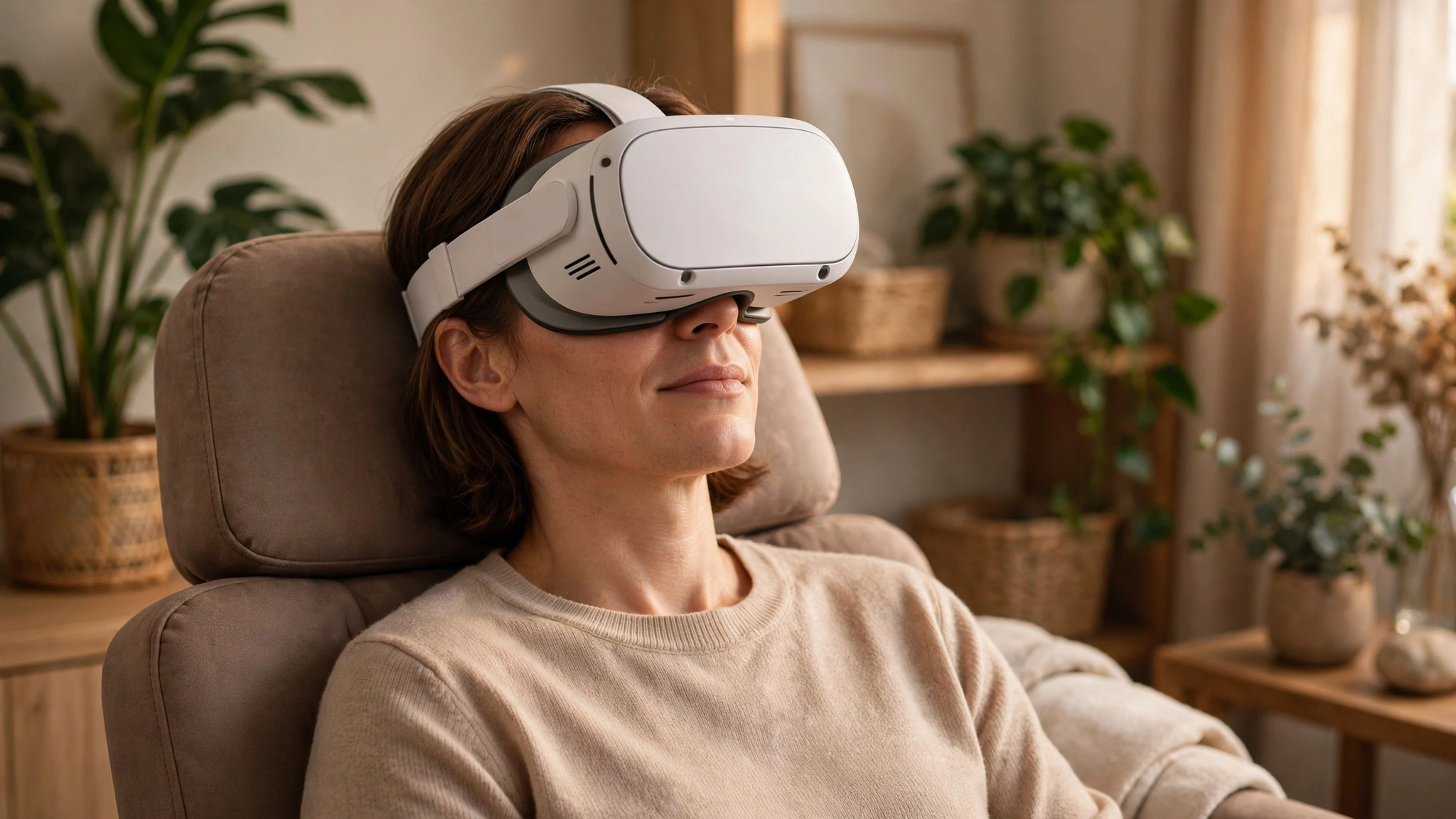
VR in Mental Health Treatment: How It Works
Imagine putting on a headset and suddenly standing on the glass floor of a skyscraper, looking down at the street far below. Your heart pounds. Your palms sweat.
But you’re actually standing safely in a therapist’s office. And that fear racing through your body? That’s exactly the point.
This is virtual reality therapy — one of the most interesting developments in mental health treatment in recent decades. A clinical tool that lets people face fears, process trauma, and practice calming skills inside carefully controlled virtual worlds. Here’s how it works, what the evidence really shows, and where its limits are.
What Is VR Therapy?
VR therapy — more precisely called virtual reality exposure therapy, or VRET — uses a VR headset to place you inside computer-generated environments designed for therapeutic purposes: a crowded elevator, an airplane, a dinner party, a peaceful forest. The scenarios are built to trigger real emotional responses in a setting that is completely safe and adjustable.
The key idea isn’t new. Exposure therapy — gradually facing feared situations instead of avoiding them — has been a cornerstone of anxiety treatment for decades. What VR adds is a middle path between two older options:
- Imagining the feared situation, which is free but doesn’t work well for everyone — some people can’t conjure vivid mental images, so the emotional response stays weak.
- Facing the real thing, which is the gold standard but can be impractical or impossible — you can’t easily stage a turbulent flight or a combat scenario on demand.
VR sits between the two: more reliably anxiety-provoking than imagination, more controllable than the real world. And it’s typically used within established therapy — most often cognitive behavioral therapy (CBT) — with a trained clinician guiding the process.
How Does It Actually Work?
The whole thing rests on a quirk of the human brain: it doesn’t need perfect graphics to react as if something is real. What matters is the sense of presence — the feeling of actually being inside the virtual space. When presence kicks in, your nervous system responds genuinely: heart rate rises, muscles tense. A coarse, cartoonish virtual elevator can still trigger a real fear of heights.
A VR therapy program typically works like this:
- Assessment and planning. Before any headset goes on, you talk with your therapist about the problem. Together you build a “fear hierarchy” — situations ranked from mildly uncomfortable to deeply frightening.
- Graduated exposure. You enter the virtual environment at a manageable level. Afraid of flying? You might start by sitting in a virtual airplane seat on the ground. The therapist watches the same scene on a monitor and adjusts it in real time — adding turbulence or passengers as your tolerance builds.
- Habituation. The core mechanism is well understood: when you stay in a feared situation and the catastrophe your brain predicted doesn’t happen, the fear response gradually fades. VR makes these repetitions easy to run and fine-tune.
- Coaching throughout. The therapist guides you during the session — tracking your anxiety, helping you apply coping strategies. Some newer programs use an automated virtual coach instead, though this is still emerging.
What Conditions Does VR Therapy Treat?
Specific Phobias — the Strongest Evidence
This is where VR therapy has the deepest track record. Fear of heights, flying, spiders, enclosed spaces — studied since the mid-1990s, with consistently strong results. Multiple randomized controlled trials and meta-analyses show VR exposure works about as well as facing the real feared situation for phobias.
A notable milestone: a 2018 trial published in The Lancet Psychiatry tested a fully automated VR program for fear of heights — no therapist present during the VR sessions. After just six sessions over two weeks, participants showed large reductions in fear, both virtually and on real heights, and the gains held at follow-up.
PTSD — One of the Most Compelling Uses
For post-traumatic stress disorder, VR solves a problem nothing else can: how do you safely re-create the context of a trauma? Programs like Bravemind, developed at the University of Southern California, build customizable simulations — for example, combat environments for veterans — that let patients process traumatic memories under a therapist’s guidance.
A landmark study after the September 11 attacks found VR exposure therapy significantly reduced PTSD symptoms in patients who hadn’t responded to earlier treatments. A meta-analysis in Clinical Psychology Review found significant symptom reductions, with effects persisting at follow-up.
Social Anxiety and Panic
VR can simulate dinner parties, job interviews, crowded malls, and public speaking — the exact situations people with social anxiety or panic disorder avoid. The evidence here is promising but thinner than for specific phobias: social scenarios are harder to render convincingly. Still, multiple trials show symptom reductions comparable to traditional exposure.
Depression, Stress, and Relaxation
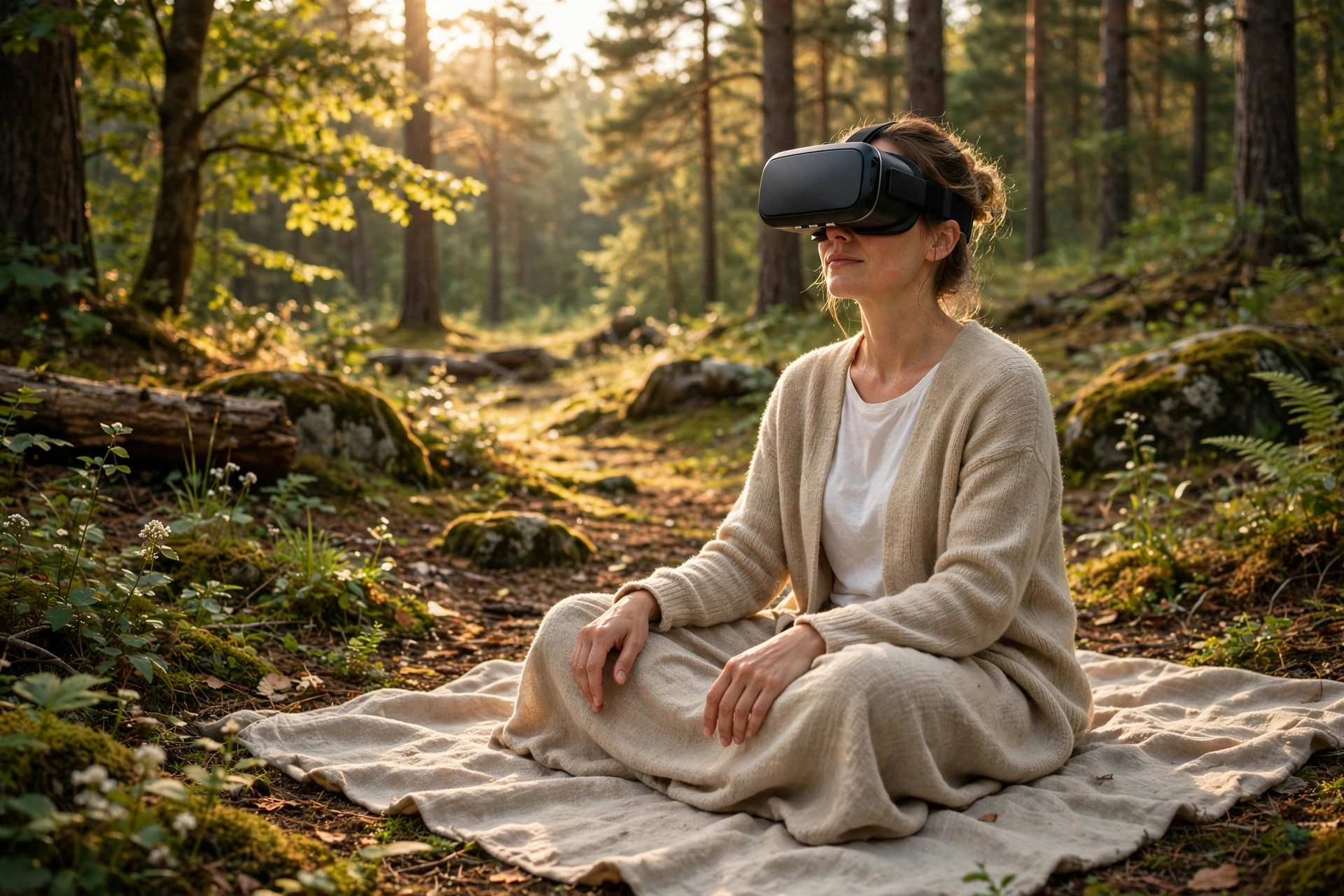
This is a newer frontier. Instead of exposure, these programs use calming virtual environments — forests, oceans, open skies — paired with guided breathing, meditation, or biofeedback. Early studies suggest VR relaxation can lower stress markers like heart rate and self-reported anxiety, and some trials report reductions in depression scores. The evidence is still emerging, and longer-term studies are needed.
Emerging Areas
Researchers are also exploring VR for agoraphobia in people with psychosis (the gameChange program, tested in the largest-ever clinical trial of VR for mental health across nine NHS trusts in the UK, helped housebound patients re-engage with everyday life), social skills practice for autistic people, pain management during medical procedures, and even eating disorders and substance use. These applications are genuinely exciting — but the evidence is at an earlier stage, and honest reporting means saying so.
What the Research Actually Shows — Honestly
It’s worth stepping back from the hype, because VR therapy attracts a lot of it. Here’s a fair summary:
- Phobias: strong evidence, comparable to the gold-standard real-world exposure.
- PTSD: moderate-to-strong evidence from multiple trials.
- Social anxiety and panic: moderate evidence, still growing.
- Depression, generalized anxiety, psychosis, pain: emerging — promising early results, but not yet on the same footing.
- Transfer to real life: a dedicated meta-analysis confirmed that improvements in VR translate to measurable improvements in real-world behavior — this was a genuine open question, and the answer is encouraging.
What VR therapy is not: a replacement for a therapist, a cure, or a consumer wellness product you should try on your own for a serious condition. The strongest results come from VR embedded in proper clinical care.
What a Typical Session Looks Like
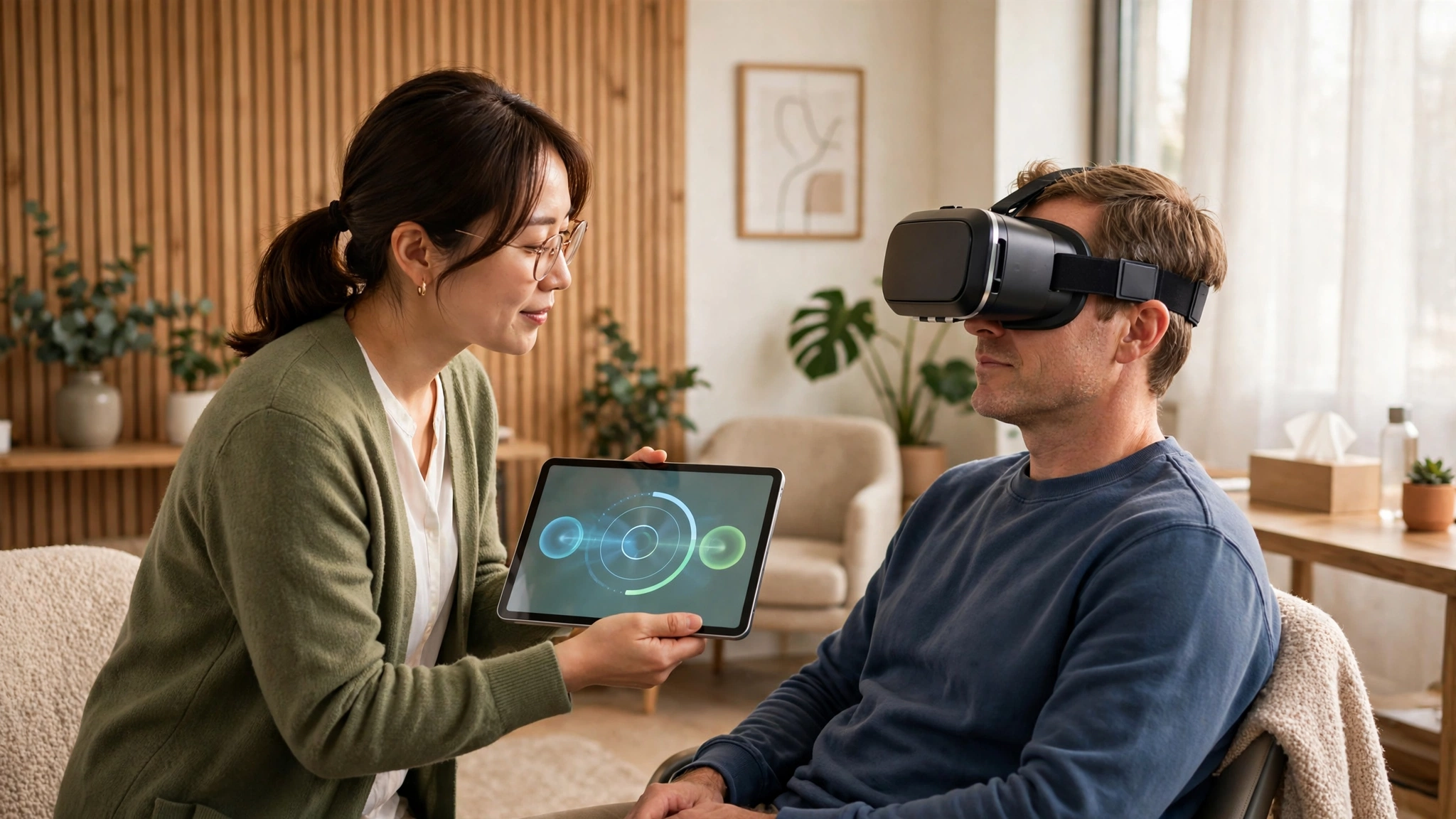
You arrive and talk — no headset yet. You and your therapist agree on the day’s target from your fear hierarchy. Then the headset goes on, and you enter the virtual scene. Your therapist sees what you see on a monitor, talks you through it, and adjusts the intensity. You might rate your anxiety from 0 to 10 at intervals. Sessions often run 45–60 minutes, and a course of treatment might be 4 to 12 sessions depending on the condition.
Afterward, you debrief: what happened, what felt different from last time. The VR is the vehicle; the therapy — the conversation, the coping strategies, the gradual retraining of your fear response — is the engine.
The Benefits Over Traditional Approaches
- Control and precision. The therapist can dial intensity up or down mid-session, pause, and repeat exact scenarios — impossible in the real world.
- Access and privacy. No need to book flights or find tall buildings; everything happens in one room, without an audience of strangers.
- Lower dropout. Because it feels safer, patients are less likely to quit — and in exposure therapy, sticking with it is half the battle.
Limitations and Risks Worth Knowing
A balanced picture needs the other side too:
- Motion sickness. So-called “cybersickness” — nausea, dizziness, disorientation from the mismatch between what your eyes see and what your inner ear feels — affects a meaningful minority of users. Newer headsets have reduced it, but for some people it limits or rules out VR therapy.
- It’s not for everyone. People with certain conditions — including some dissociative disorders, certain vestibular (balance) problems, and in some cases active psychosis — may not be suitable candidates. A proper clinical assessment comes first.
- The avoidance trap. If a patient rips the headset off the moment anxiety spikes, they may be practicing avoidance rather than habituation. This is exactly why trained guidance matters — the technique only works when done correctly.
- Cost and availability. Clinical-grade VR systems can cost thousands of dollars plus software licensing, which limits how many practices offer it. Consumer headsets ($300–$500) are increasingly being validated for clinical use, bringing costs down — but VR therapy is still far from universally available.
- Privacy. VR systems can collect sensitive data — head movement, gaze direction, even physiological signals. Patients should ask how that data is stored, who can access it, and how long it’s kept. Standards here are still catching up.
- Not a DIY treatment. Consumer VR apps marketed for “anxiety relief” are not the same as clinician-guided VR therapy. For a diagnosed condition, the evidence supports the clinical version.
Questions to Ask Before Trying VR Therapy
If you’re considering it, these questions will help you find a reputable provider:
- Are you a licensed mental health professional, and what training do you have in VR-assisted therapy?
- What is the evidence for VR therapy for my specific condition?
- How does VR fit into my overall treatment plan — is it part of CBT or another established therapy?
- What happens if I feel sick or overwhelmed during a session?
- How is my data handled — what’s collected, stored, and shared?
- How many sessions do you expect, and what does it cost?
Good providers will welcome these questions. Evasive answers are a red flag — for VR therapy or any therapy.
The Bottom Line
VR in mental health treatment has come a long way from the clunky headsets of the 1990s — and remarkably, even those early systems produced real results. Today, the evidence is strongest for phobias and PTSD, growing for social anxiety and panic, and emerging for everything else. It offers something genuinely new: the emotional power of real experience with the safety and control of a simulation.
But it’s a tool, not a miracle. It works best in the hands of a trained clinician, as part of proven therapy — and anyone selling it as a quick fix or a replacement for professional care is selling something the research doesn’t support.
This article is for informational purposes only and is not medical advice. VR therapy should be undertaken with a qualified mental health professional. If you are struggling with a mental health condition, please talk to a doctor, counselor, or therapist about whether VR-assisted treatment is appropriate for you.