How the Respiratory System Works: Its Parts, Functions, and Breathing
The respiratory system is the network of organs and tissues that moves air in and out of the body and swaps oxygen for carbon dioxide. It includes the nose, mouth, throat, voice box, windpipe, airways, lungs, and the muscles that power breathing. Together with the circulatory system, it delivers oxygen to every cell and carries carbon dioxide away. This guide explains each part of the respiratory system, how breathing works, and how gas exchange keeps the body running. For an authoritative overview, see the NHLBI guide to the respiratory system.
Contents
- What Is the Respiratory System?
- The Main Parts of the Respiratory System
- How Breathing Works: Inhalation and Exhalation
- How Oxygen and Carbon Dioxide Are Exchanged
- How Oxygen Travels Through the Blood
- How the Body Controls Breathing
- Other Functions of the Respiratory System
- Common Problems That Affect the Respiratory System
- Simple Habits That Support Respiratory System Health
- Frequently Asked Questions About the Respiratory System
What Is the Respiratory System?
The respiratory system has two closely linked jobs: ventilation, the movement of air into and out of the lungs, and gas exchange, the transfer of oxygen and carbon dioxide between air and blood. These two jobs are distinct, because moving air into the lungs does not by itself deliver oxygen to cells. Oxygen must cross thin lung surfaces and enter the bloodstream, while carbon dioxide follows the reverse route.
The system is usually divided into the upper and lower respiratory tracts. The upper tract includes the nose, nasal cavity, mouth, and much of the pharynx, or throat. The lower tract includes the larynx, trachea, bronchi, smaller airways, and lungs. In addition, it works closely with the heart and blood vessels, the brain, and the muscles of the chest wall. Breathing runs automatically most of the time, yet it can also be changed on purpose for speech, singing, or a slow breath. To learn more about whole-body health, visit our general health section.
The Main Parts of the Respiratory System
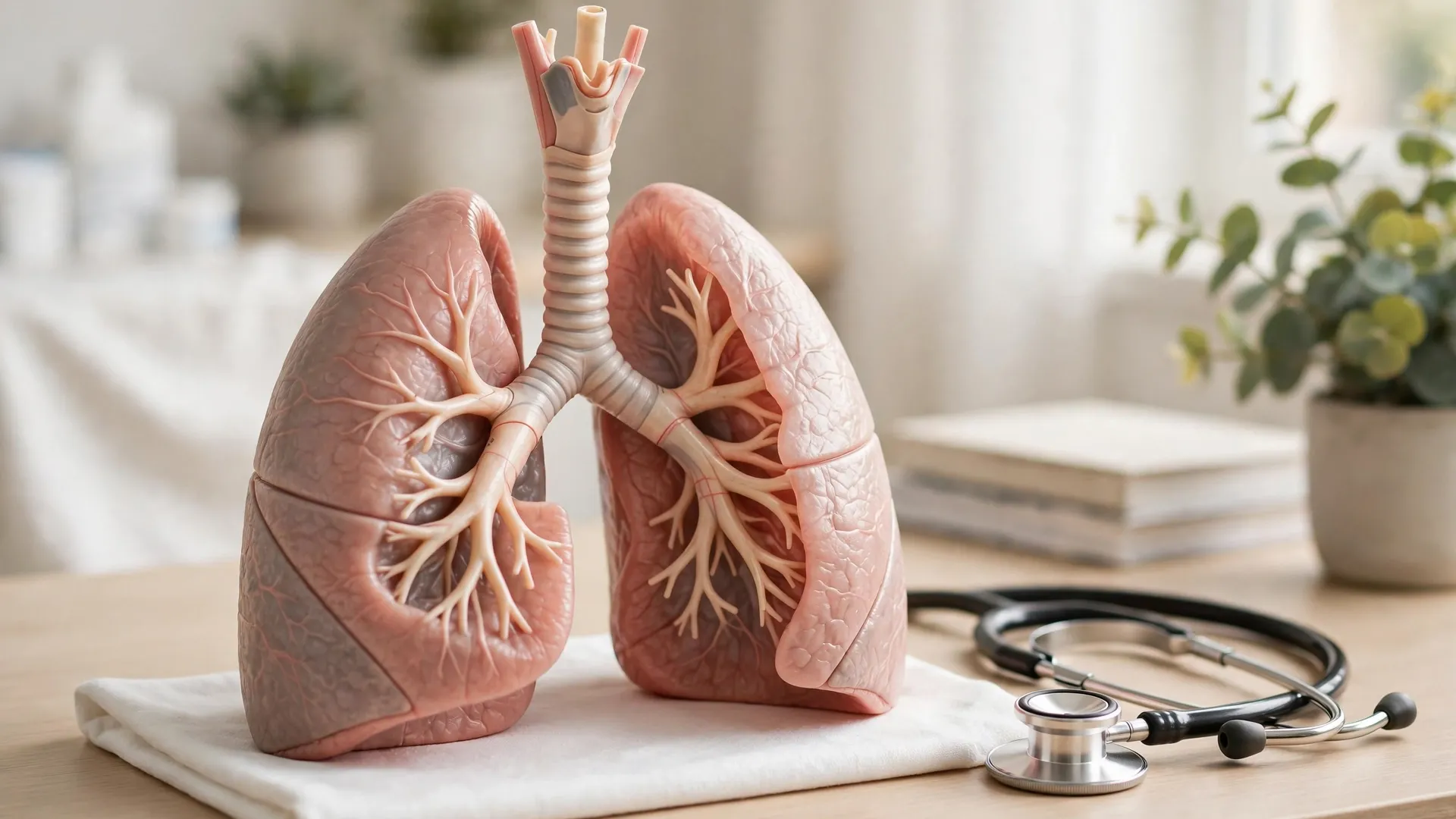
The larger airways conduct air, the smaller airways spread it through the lungs, and microscopic structures provide the surfaces where gases enter and leave the blood.
Nose and Nasal Cavity
The nose is the main entrance for air during quiet breathing. Inside it, the nasal cavity is lined with a moist membrane and contains curved bony structures called conchae. Together, they warm, filter, and humidify incoming air, while nasal hairs and mucus trap dust and pollen. The upper part of the nasal cavity also holds the smell receptors.
Mouth and Pharynx
The mouth serves as a backup passage for air, especially during exercise or when the nose is blocked, but it does not warm, filter, or humidify air as well. Behind the nose and mouth lies the pharynx, a muscular passage shared by the respiratory and digestive systems. Because these pathways cross in the throat, swallowing needs careful coordination, so food goes to the stomach and not into the airway.
Larynx (Voice Box)
The larynx, commonly called the voice box, connects the pharynx to the trachea. It holds the vocal folds, which vibrate as air passes through them to produce sound, with changes in tension and airflow creating different pitches and volumes. The larynx also helps with coughing, which forces unwanted material out of the lower airways. Near its entrance sits the epiglottis, a flap of tissue that helps protect the airway during swallowing.
Trachea (Windpipe)
The trachea, or windpipe, is a flexible tube that carries air from the larynx toward the lungs. C-shaped rings of cartilage keep it open while still letting the esophagus behind it expand when food is swallowed. Its inner surface is lined with mucus and cilia, which trap particles and move them upward toward the throat.
Bronchi and Bronchioles
At its lower end, the trachea divides into the right and left main bronchi, one leading to each lung. These branches divide again and again into smaller bronchi and then bronchioles, spreading air from one large passage into a wide network of narrower tubes, like an upside-down tree. The larger bronchi contain cartilage that supports their walls. As the airways get smaller, smooth muscle plays a bigger role in controlling airway width, so narrowing can make breathing hard, as in asthma.
Lungs
The lungs are two spongy, elastic organs inside the chest. The right lung usually has three lobes, while the left has two. Each lung holds a branching network of airways, blood vessels, and millions of tiny air sacs. The lungs are not pumps like the heart. Instead, they expand and recoil as pressure changes produced by the diaphragm and other muscles, and each lung is wrapped in the pleura, a thin double membrane that reduces friction during breathing.
Alveoli
The alveoli are tiny, thin-walled air sacs at the ends of the airways, and they are the main sites of gas exchange. Their walls are extremely thin and sit close to a dense network of capillaries, the smallest blood vessels. Oxygen crosses this thin barrier from the air inside the alveoli into the blood, while carbon dioxide crosses in the opposite direction. Healthy adult lungs hold roughly 300 to 500 million alveoli, with a combined surface area of about 70 square metres, and type II cells make surfactant, which helps stop the alveoli from collapsing when you breathe out.
Diaphragm and Breathing Muscles
The diaphragm is the main muscle of breathing, a dome-shaped sheet below the lungs that separates the chest from the abdomen. The intercostal muscles between the ribs also help move the chest wall. During quiet breathing, these two groups do most of the work, and when demand rises, extra muscles in the neck, chest, and abdomen join in.
How Breathing Works: Inhalation and Exhalation
Breathing, also called pulmonary ventilation, depends on pressure differences. Air moves from areas of higher pressure to areas of lower pressure, so the chest must change volume to draw air in or push it out. This simple rule drives every breath.
During inhalation, the diaphragm contracts and moves downward, while the external intercostal muscles lift the ribs and expand the chest. The pressure inside the lungs then falls slightly below the outside pressure, so air flows into the alveoli. Inhalation is an active process, because it needs muscle contraction.
During quiet exhalation, the diaphragm and intercostal muscles relax. The chest cavity becomes smaller, and the elastic tissues of the lungs recoil toward their resting size. This raises the pressure inside the lungs slightly above the outside pressure, which pushes air outward. Quiet exhalation needs little active effort. However, forceful exhalation, such as during exercise, coughing, or blowing out candles, uses the abdominal muscles and internal intercostals to squeeze the chest further. The lungs never empty fully, and the air left behind keeps them from collapsing.
How Oxygen and Carbon Dioxide Are Exchanged
Gas exchange happens mainly by diffusion, which is the movement of molecules from an area of higher partial pressure to an area of lower partial pressure. In the lungs, the partial pressure of oxygen is normally higher in the alveolar air than in the oxygen-poor blood arriving from the body. Oxygen therefore diffuses across the thin alveolar-capillary membrane into the blood. At the same time, carbon dioxide has a higher partial pressure in the incoming blood than in the alveolar air, so it diffuses into the alveoli and leaves during exhalation. The InformedHealth guide to how lungs work explains this process in plain language.
Efficient exchange needs a good match between ventilation, the delivery of air to the alveoli, and perfusion, the delivery of blood to the surrounding capillaries. If an area of lung gets air but little blood, or blood but too little air, gas exchange becomes less effective, and less oxygen enters the bloodstream.
How Oxygen Travels Through the Blood
Once oxygen enters the blood, most of it binds to hemoglobin, an iron-containing protein inside red blood cells. Each hemoglobin molecule can carry several oxygen molecules, so blood transports far more oxygen than could dissolve in its liquid part alone. Pulmonary veins then carry this oxygen-rich blood to the left side of the heart, which pumps it to the body’s tissues.
At the tissues, oxygen leaves the blood and enters cells, where it is used in aerobic respiration to release usable energy. Meanwhile, carbon dioxide enters the blood, travels back to the lungs, and leaves the body when you breathe out.
How the Body Controls Breathing
Breathing is controlled automatically by networks of nerve cells in the brainstem, mainly in the medulla oblongata and the pons. These networks set the rhythm and send signals to the diaphragm and other breathing muscles. The NHLBI guide to how the body controls breathing describes the muscles and nerves involved in detail. The brainstem also works with the hypothalamus, which helps coordinate the body’s response to stress, temperature, and sleep.
Chemical sensors fine-tune the rhythm. Central chemoreceptors respond mainly to carbon dioxide and acidity in the fluid around the brain, while peripheral sensors in the carotid and aortic bodies track blood oxygen, carbon dioxide, and acidity. Under ordinary conditions, carbon dioxide is the main driver: when it rises, breathing becomes faster or deeper. The brain also blends signals from movement, emotion, and temperature, so breathing matches the body’s needs. It can be changed on purpose for speech or a slow breath, but voluntary control has limits.
Other Functions of the Respiratory System
Gas exchange is the main job, but the system does several other useful things. First, it filters, warms, and humidifies every breath, which protects the lower airways from cold, dry air and dust. Second, it defends against germs, because mucus traps particles and cilia sweep them away. Third, it makes speech possible, since airflow through the vocal folds creates sound. Fourth, it supports the sense of smell. Fifth, it helps regulate blood pH, because changing how much carbon dioxide is breathed out shifts blood acidity. Finally, coughing and sneezing clear the airways.
Common Problems That Affect the Respiratory System
Many conditions can affect the respiratory system, and they often share symptoms such as a persistent cough, wheezing, shortness of breath, or chest tightness. Asthma narrows the airways through inflammation and muscle tightening. COPD, which includes chronic bronchitis and emphysema, damages the airways and alveoli over time, often after years of smoking. Infections such as colds, flu, bronchitis, and pneumonia inflame the airways or fill the alveoli with fluid, while allergies can swell the nasal passages.
Other problems include sleep apnea, in which breathing pauses during sleep, and pulmonary embolism, in which a clot blocks a lung blood vessel. Lung cancer and interstitial lung disease damage lung tissue itself. Doctors diagnose these problems with a history, an examination, breathing tests, and imaging such as a CT scan. Early care matters, because many breathing problems respond better when found early.
Simple Habits That Support Respiratory System Health
You cannot control every risk, but several everyday habits support the respiratory system. First, avoid smoking and secondhand smoke. Second, stay active, because regular movement strengthens the breathing muscles. Third, practice slow, deep breathing, which can ease stress. Fourth, keep indoor air clean by dusting and airing rooms. Fifth, wash your hands often and keep vaccines up to date, since infections strain the airways. Finally, seek care promptly for a cough that lasts more than a few weeks, wheezing, or breathlessness that is new or getting worse.

Frequently Asked Questions About the Respiratory System
What is the respiratory system?
The respiratory system is the network of organs and tissues that handles breathing and gas exchange. It includes the nose, mouth, throat, voice box, windpipe, airways, lungs, and breathing muscles. Its main job is to bring oxygen into the blood and remove carbon dioxide from the body.
What are the main parts of the respiratory system?
The main parts are the nose and nasal cavity, mouth, pharynx, larynx, trachea, bronchi, bronchioles, lungs, alveoli, and diaphragm. The upper parts conduct and condition the air, while the lower parts spread it through the lungs, and the alveoli are where oxygen and carbon dioxide swap places with the blood.
How does the respiratory system work?
Air enters through the nose or mouth, travels down the trachea, and branches through the bronchi and bronchioles into the alveoli. There, oxygen diffuses into the blood and carbon dioxide diffuses out, and the heart then pumps oxygen-rich blood to the tissues.
What is the difference between breathing and respiration?
Breathing, or ventilation, is the physical movement of air in and out of the lungs. Respiration is the wider process, which includes gas exchange in the lungs and the use of oxygen by cells to release energy.
How many alveoli do humans have?
Healthy adult lungs hold roughly 300 to 500 million alveoli, with a combined surface area of about 70 square metres. This huge area makes gas exchange fast and efficient, while damage to the alveoli, as in emphysema, makes breathing harder.
What controls how fast we breathe?
The brainstem controls breathing automatically, mainly through groups of nerve cells in the medulla and pons. Chemical sensors track carbon dioxide, oxygen, and acidity in the blood and adjust the rate and depth of breathing, and carbon dioxide is usually the strongest signal.
Can you improve your lung capacity?
Regular aerobic exercise can improve how efficiently the lungs and heart work together, and breathing exercises can strengthen the diaphragm. However, the total volume of the lungs is mostly set by body size and age, so the best gains come from staying active, avoiding smoke, and treating any lung condition early.
When should I see a doctor about breathing?
See a doctor promptly for new or worsening shortness of breath, wheezing, chest pain, coughing up blood, or a cough lasting more than three weeks. Also seek care if breathing problems disturb sleep or limit daily activity, since early checks can catch problems while they are easier to treat.
Conclusion
The respiratory system moves air, swaps gases, and keeps every cell supplied with oxygen. Its parts work as a team: the nose and airways condition and carry air, the alveoli exchange gases with the blood, and the diaphragm and brainstem set the rhythm. Simple habits such as avoiding smoke, staying active, and seeking care early protect it for life.
This article is for general information only and is not medical advice. If you have ongoing breathing problems, talk to a healthcare professional.